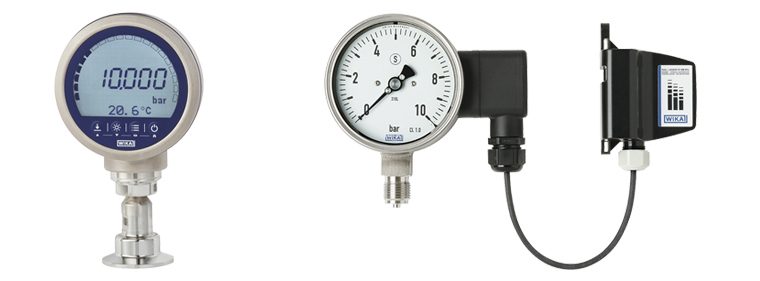

IN the course of the digitalisation of processes, the topic of “ignition protection type for battery-operated pressure measuring instruments” is coming up more and more frequently. This is because, among other things, companies are increasingly replacing purely mechanical measuring instruments with electrical combination models with an on-site indication and a radio unit for data transmission. These instruments usually have long-life batteries as a power source.
The measuring locations fitted with these instruments, in turn, are often located in potentially explosive environments, for example in the chemical industry.
Plant operators generally prefer two ignition protection types for pressure measuring instruments in explosive atmospheres: Ex i (intrinsically safe) and Ex d (explosion-proof enclosure). Both are standardised types of protection and are therefore classified as equally safe within a category. In the case of pressure and other measuring instruments, this is electrical equipment, suitable for gas or gas-and-dust atmospheres depending on the approval.
Why Wika uses the Ex i ignition protection type for pressure measuring instruments with battery operation can be explained by looking at its definition: An intrinsically safe design prevents the instrument from igniting an explosive atmosphere at all. Its values for power, current and voltage are correspondingly low. This is the case with pressure and other measuring instruments with battery operation.
With ignition protection type Ex d, the possible values for current and voltage are significantly higher than with Ex i. In addition, ignition sources can also be present in the instruments themselves. For this reason, their housings must be encapsulated in an explosion-proof manner so that any possible explosion cannot escape to the outside.
The Ex i ignition protection type is indeed linked to more regulations than just the values for power, current and voltage. In the case of battery operation, however, these alone remain the decisive criteria. This is because instruments with such a power supply are not electrically connected to any PLC outside the Ex zone, for example. They transmit the measured values via a radio unit and/or display them on-site. This eliminates the otherwise necessary galvanic isolation of the measuring instrument and the PLC through the installation of an Ex-certified power supply, as well as the additional documentation effort – one certificate for each Ex i circuit.