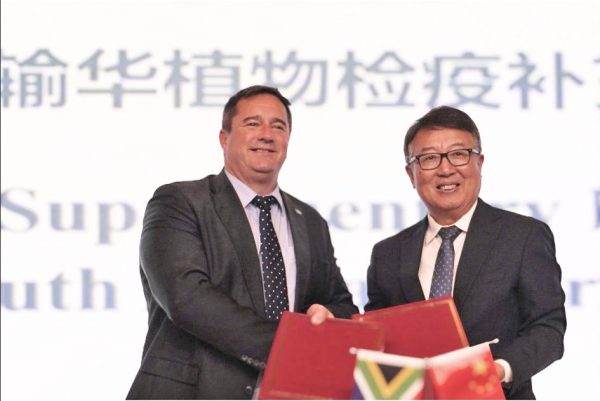

THE Department of Agriculture (DoA) and the Citrus Growers’ Association of Southern Africa (CGA) welcomes the successful amendment of the plant health protocol governing the export of South African citrus to China. This development is expected to deliver tangible benefits across the value chain – both in China and in South Africa.
“South Africa places a high value on its relationship with China, which continues to create meaningful opportunities across our agricultural sector,” said Minister of Agriculture in South Africa, John Steenhuisen. “These agreements are the result of trust, respect and sustained cooperation, and they are helping open doors for our producers at a time when diversification has never been more important.”
The amended protocol introduces additional phytosanitary pest risk mitigation treatment options, reflecting a science-based and risk-managed approach to plant health compliance. The outcome, firmly based on scientific outputs from Citrus Research International (CRI), is the result of collaborative engagement between South African and Chinese authorities.
The inclusion of improved treatment options is anticipated to increase the quality of fruit reaching Chinese consumers, while also reducing costs and improving export efficiencies for South African producers and exporters. The amendment is set to significantly boost South Africa’s citrus presence in the Chinese market.
China is a well-established destination for South African citrus, particularly Navel oranges, lemons and grapefruit, which are categories valued by Chinese consumers. While exports to China and Hong Kong accounted for approximately 11.5 million cartons (6%) of total exports in 2025, there is significant opportunity to expand this share, supported by strong consumer demand and complementary seasonal supply. South Africa’s citrus industry provides counter-seasonal supply to the Chinese market. This complements China’s domestic production by keeping consumers within the category year-round.
At the signing ceremony in Pretoria, Chinese Ambassador Wu Peng said: “South African citrus has excellent quality and complements China’s domestic citrus production due to your counter-seasonal supply. That is a very positive contribution to Chinese consumers’ fruit baskets.
“With China’s huge market of 1.4 billion people, our cooperation has enormous potential and bright prospects. This agreement for further access to the Chinese market cannot be more timely because South Africa’s citrus season this year is just beginning and going very strong. It reflects the high level of China-South Africa bilateral relations and the deep friendship between our peoples.”
CGA CEO Dr Boitshoko Ntshabele said: “The CGA remains committed to working closely with government and international partners to strengthen market access, uphold high phytosanitary standards and support the sustainable growth of the citrus industry.”
Ntshabele expressed the CGA’s appreciation to South African and Chinese authorities for their collaboration in achieving this milestone and affirmed the Association’s commitment to continued partnership in advancing mutually beneficial trade.
The CGA has also welcomed recent progress in broader economic cooperation between South Africa and China through the Economic Partnership Agreement Framework signed in February 2026, as well as announcements related to planned unilateral tariff reductions. Once finalised, these developments are expected to enhance the competitiveness of South African citrus in the Chinese market. The CGA continues to advocate for citrus to be included in the so-called “Early Harvest agreement”, which would allow the industry to benefit from these tariff improvements as early as possible in the 2026 season.
South Africa’s citrus industry remains a cornerstone of the country’s agricultural performance and export earnings. In 2025, Southern Africa exported approximately 204 million cartons of citrus, with South Africa accounting for approximately 193 million cartons, reinforcing its position as the second-largest citrus exporter globally. Export earnings exceeded US$2 billion for the first time, reaching an estimated US$2.47 billion in foreign exchange revenue.
The citrus industry supports approximately 140,000 direct jobs at farm and packhouse level, with substantially broader employment created across the value chain, including logistics, export services and international distribution. As such, the citrus sector forms the economic heart of many rural communities across the country and continues to play a critical role in driving inclusive growth and sustained rural development.