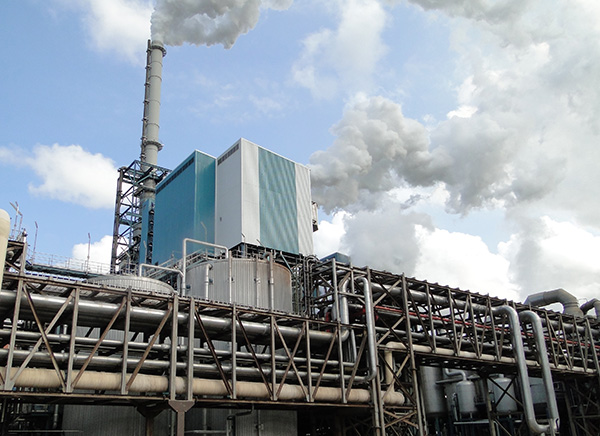

SAPPI Southern Africa reached an agreement with the Green Scorpions (Environmental Management Inspectorate – EMI), pertaining to environmental contraventions at the Saiccor Mill in Umkomaas, as identified during an audit conducted in 2014.
The agreement follows extensive engagements that commenced in 2021, after Sappi was first notified of findings by the EMI during 2017, according to Sappi SA.
The company reports that the agreement included payments of R5 million to the eThekwini Municipality and R3 million to the Criminal Assets Recovery Account which would be concluded before April 28, 2023.
eThekwini Municipality said that it welcomed the decision by the Scottburgh Regional Court to fine Sappi for polluting the air through excessive sulphur dioxide emissions.
The municipality said that the emissions, which exceeded the legal limit set by the Air Quality Act, were released from the Saiccor Mill between July 2012 to December 2014. It said that the City’s Environmental Health Unit, in collaboration with the South African National Air Quality Officer, started investigations in 2014 following a review of Sappi’s monthly, quarterly, and annual reports. The municipality credited Sappi for cooperating with the investigation and acknowledging responsibility for the excessive emissions.
Sappi says that the company has been taking proactive mitigating actions to reduce emissions and impact over the past two decades, and has invested more than R20 million on various upgrade interventions and maintenance programmes pertaining to water consumption and air emissions between 2017 and 2022. A further approximate R100 million has been committed to upgrades between November 2022 and March 2024.
Sappi concluded an extensive expansion and environmental upgrade project at the Saiccor mill during 2022, of which R3.8 billion was invested to achieve a reduction in the mill’s water consumption, effluent, waste to landfill, SO2 emissions and CO2 fossil emissions.
eThekwini Municipality chairperson of the Community Services Cluster, Councillor Zama Sokhabase lauded the efforts of the city’s environmental health team. She said the fine is proof that the city is taking the implementation of the National Environmental Management Act No. 107 of 1998, together with the National Environment Management: Air Quality Act 39 of 2004, seriously. “The role of our environmental health team is to monitor compliance with issued atmospheric emission licences so that we can reduce emissions that are a health threat to our communities. We will continue to do this to ensure that communities can enjoy their right to a clean and safe environment.”
Validation and target-setting
Sappi said that it has amplified its response to climate change through the validation of its science-based targets by the Science Based Targets initiative (SBTi: a global partnership which defines and promotes best practice in emissions reductions and net-zero targets in line with climate science.) Far-reaching decarbonisation plans are already underway in each of the regions it operates in, whilst also motivating suppliers to adopt their own science-based targets. Most recently, Sappi again achieved Platinum status in the annual EcoVadis Corporate Social Responsibility (CSR) ratings, placing it in the top 1% of over 90,000 companies assessed by EcoVadis, where companies are evaluated for their performance in terms of a total of 21 criteria divided into four general areas: environment, labour and human rights, ethics, and sustainable procurement.