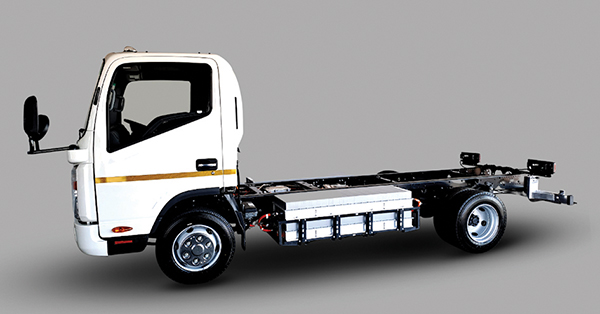

JAC Motors South Africa announced the introduction of its new N75 EV as part of its local N-Series truck line-up due to substantial interest from local transport operators. Battery-electric trucks are emission-free and offer major cost savings and multiple benefits to fleet operators, including reducing their carbon footprint and environmental impact.
The market’s interest in the N55 EV 3.5-tonne truck convinced the company to introduce the new N75 EV 4-tonne truck as a permanent fixture on its official price list. It will do duty next to the versatile N75 6-tonne truck powered by the reliable Euro 3, 3.8L Cummins ISF engine.
“The new N75 EV is an excellent example of our global drive to offer green mobility solutions to transport operators who want low running costs and reliability while minimising their impact on the environment,” says CEO of JAC Motors South Africa, Karl-Heinz Göbel.
JAC Motors, a strong contender in the global truck market, started in 1964 as a truck manufacturer. The company extended its business into passenger vehicles and bakkies in 2007 and has been manufacturing battery-electric trucks since 2014. Its current electric truck platforms range from 2.5 to 12 tonnes, offering flexible weight and wheelbase options to suit particular tasks on the same vehicle frames.
Over the past decade, JAC Motors has refined the design and engineering of its popular N-Series to ensure excellent performance, low running cost and driver safety. The addition of the battery-electric derivatives to its N-Series is evidence of the company’s vision of a zero-emission future for JAC trucks, focusing on efficient, cost-effective battery-electric trucks.
Adding a battery-electric truck to the N75 line-up shows JAC Motors’ confidence in alternative energy solutions. The N75 EV features a 65 kW (130 kW peak power) synchronous electric motor with 415/1 200 Nm of torque. It is powered by a 106.95 kWh LFP battery pack that allows for a reach of 200 km per charge.
The N75 EV features an economical driving mode and uses regenerative braking to maximise battery life and range. It accelerates from 0 to 50 km/h in eight seconds, achieves a top speed of 90 km/h and can scale up to 16.7 degrees with a load of four tonnes.
Reliable powerplants and drivetrains for local conditions
When a DC fast charger with a standard European CCS2-Combo connection is used, the battery recharges in approximately two hours, offering a range of 200 km. Compared to a conventional internal combustion engine (ICE) truck, the N75 EV saves 50% on fuel/energy costs.
JAC Motors’ state-of-the-art fault diagnostic and vehicle monitoring and control systems ensure that the N75 EV’s health always exceeds the expectation levels of transport operators. It was also subjected to
extensive fire and waterproof testing to ensure the vehicle remained safe under extreme conditions.
“The N75 EV is an economical, reliable and safe solution for last-mile deliveries. Over and above the massive fuel/energy cost saving compared to conventional ICE trucks, the N75 EV’s maintenance cost is also 70% lower,” says Göbel.
The N75 6-tonne truck with its reliable Euro 3, 3.8-litre Cummins ISF four-cylinder common-rail turbodiesel engine, is a popular choice with transport operators, mainly because of its durability, low total cost of ownership (TCO) and versatility. The proven powerplant produces 115 kW at 2 600 r/min and 500 Nm of peak torque between 1 200 and 1 900 rpm.
It features a hydraulic-assisted Single Dry Plate clutch linked to a synchromesh six-speed manual transmission. The drivetrain setup allows for low engine RPMs at cruising speeds, reducing fuel consumption. Its average fuel consumption is 15.1 L/100 km (combined cycle). It features an exhaust brake system for maximum braking efficiency.
“Our 6-tonne truck appeals to a broad customer base across various industries. Transport operators are especially impressed with its fuel efficiency, performance, versatility and everyday functionality,” says Göbel.
The N75 range benefits from JAC Motors’ new heavy-duty ladder-frame chassis stamping and welding treatment process, making it robust for many different body applications.