

GROWTHPOINT Properties is turning to solar and generators to ensure its buildings and tenants’ businesses remain powered up during South Africa’s electricity crisis resulting from Eskom’s more frequent and longer loadshedding outages.
With 13.5 MW of installed renewable energy generation across two dozen rooftop and carport solar plants and several MWp under construction, together with 332 MW of generation potential from 330-plus backup generators, Growthpoint is helping to keep the lights on at nearly 3 000 big and small businesses across the country.
“At least 1 053 shops, 833 office tenants and 38 industrial tenants are in a position to continue operating through loadshedding as a direct result of Growthpoint’s national energy management programme. In addition, all of the nearly 1 000 tenants of the V&A Waterfront, which Growthpoint co-owns, have full access to backup power from the precinct’s 48 generators,” reports Growthpoint Properties SA CEO, Estienne de Klerk.
“In this way, Growthpoint is helping local businesses avoid business disruption during power outages and, in the process, safeguarding businesses, jobs and livelihoods,” adds De Klerk.
Growthpoint provides generator backup power to just over 70% of its office portfolio by gross lettable area, offering standby power for a whopping 1.2 million sqm of offices with 223 generators. State-of-the-art technology has been implemented to monitor diesel levels. The company also has a supply chain of in-house capabilities and external providers working to keep them fuelled and operating.
In the remaining office space, most tenants have their own power solutions, or buildings are in areas that do not experience major loadshedding, for instance, parts of Pretoria and Cape Town, near national key points. There are some office buildings without generators, and Growthpoint is reassessing these requirements.
At industrial properties, tenants generally use their own generators, however, the company provides backup power across three industrial parks in its portfolio, accommodating multiple tenants in 84 153 sqm.
Nine of Growthpoint’s malls have 100% backup power generation, with the tenth currently being added. At shopping centres, the complexity of the electrical reticulation often doesn’t allow a single source of backup power across an entire mall. Where this is the case, Growthpoint provides standby power to common areas. Larger retailers often have their own systems, and smaller tenants are encouraged to use their own battery-powered uninterrupted power supply (UPS).
“We know that fast food, sit-down restaurants, and some service tenants are particularly impacted by loadshedding. Wherever shopping centres are without 100% backup power but have additional standby capacity, to support these tenants we are adding them to shopping centres’ backups where possible,” notes De Klerk.
While this goes a long way to help address the immediate need to power thousands of businesses, it comes at a cost – a significant capital outlay, a substantial monthly diesel bill, and the toll that fossil fuels have on the environment.
Growthpoint spent just over R47 million on diesel to power all its buildings in the six months from July to December 2022. The monthly bill topped R10 million in both October and December 2022 and was just short of this figure in November.
“The costs are substantial, but the burden is mostly shared, with tenants paying for their own additional diesel consumption costs,” confirms De Klerk.
A concern is the environmental impact of load-shedding, which is forcing businesses to burn diesel at unprecedented rates. As with other businesses, this weighs on Growthpoint’s strategy to be carbon neutral by 2050 and counteracts its environmental goals.
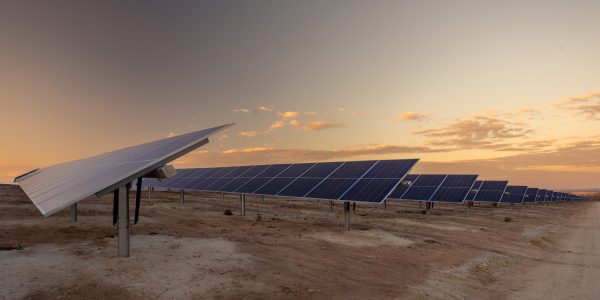
The company launched an innovative programme of green building and green energy well over a decade ago. To replace electricity generated by fossil fuels with renewable energy in its portfolio, Growthpoint has already invested in 13.5 MW of solar generation capacity and plans to double this by June 2023.
“Our investment in solar power reduces our reliance on the national grid. There is a great need for this right now and amping up our investment in solar makes perfect sense for our strategic, operational and environmental, social and governance (ESG) goals,” says De Klerk.
Of its 24 solar installations, half are at office and mixed-use properties, nine at shopping centres and three at industrial buildings. However, retail installations represent the highest capacity by far, accounting for a combined 9.4 MW.
Growthpoint’s largest solar installation undertaken this year is the 2.5 MW plant at Paarl Mall in the Western Cape, which is paired with a 4.5 MWh battery system to form a hybrid renewable energy and storage system. This is the first battery system of its size to be used at a shopping centre in South Africa, and Growthpoint is currently evaluating battery backup for other properties in its portfolio.
With 13.9 MW of solar projects in various phases of construction, the company is on track to achieve its target of 27.4 MW of installed solar by its 30 June 2023 financial year-end.