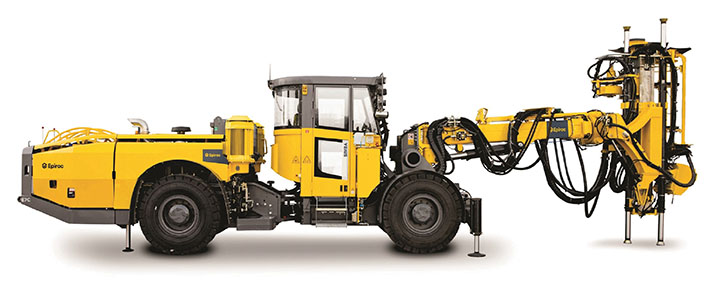

A NEW long-hole production drill rig for medium to large-sized drifts offers cutting-edge automation features and excellent drilling quality as well as an optimisation method that continuously improves how the machine is used in the process.
What makes Simba E70 S the next obvious step in production drilling is not its automated features alone. It is also the ability to track and evaluate its performance, then optimise accordingly. This is made possible by production reporting; the first step in Epiroc’s optimisation program.
“Our new Simba E70 S delivers greater value to our customers’ operations through improved productivity, with zero compromise on quality”, says Epiroc underground division vice-president sales and marketing: Sarah Hoffman.
The Simba E70 S is part of the company’s smart series and can also be delivered with the optional battery-electric driveline for reduced environmental impact and healthier underground conditions.
More metres, more value
The real value is created while the machine is producing metres. That is why the ability to track effectiveness and utilisation – if the drill is active and produces meters – is one of its main advantages.
“The connected Simba E70 S provides us with performance and quality data, so we can take the first step towards providing tailored process management to our customers”, says Epiroc underground division global product manager production drilling, Mikael Larslin.
“After tracking effectiveness and utilisation, we compare the result to global benchmarks. In that way, we can easily analyse if the machine is being used in the most optimal way or if there is room for improvements”,” says Epiroc underground division global portfolio manager production drilling, Olav Kvist.
“Increased utilisation is the main goal. By guiding customers through a structured step-by-step optimisation program, we can increase their efficiency and profits over time. Change management based on data and reports is the real customer value,” Kvist says.
While the optimisation journey progresses, the operator’s role changes as well. “As the process becomes more automated, the operator goes from running the drill to supporting it when running in automated mode, upskilling and making them more of a process operator”, says Larslin.
“All in all, it is the obvious next step in production drilling, says Kvist.