
THE Minister of Forestry, Fisheries and the Environment, Willem Abraham Stephanus Aucamp, has called for public comment on a major infrastructure proposal by Transnet National Ports Authority (TNPA) to reclaim land from coastal waters at the Port of Durban.
Reclamation of land from the sea involves the creation of new land in the sea.
The proposed reclamation represents a critical step in South Africa’s port modernisation strategy, balancing economic growth ambitions with environmental oversight as Durban seeks to strengthen its role in regional and global trade.
The Integrated Coastal Management Act defines it as “the process of artificially creating new land within coastal waters, and includes the creation of an island or peninsula, but excludes beach replenishment by sand pumping for maintenance purposes” (Section 7B(3)(c) of the National Environmental Management: Integrated Coastal Management Act, 2008 (Act No. 24 of 2008), (ICM Act) and regulations 2 and 3 of the Reclamation of Land from Coastal Waters Regulations, 2018 (GN R206 of 9 March 2018).
The application, submitted under Section 7B of the National Environmental Management: Integrated Coastal Management Act, 2008 (ICM Act), seeks in-principle approval for the creation of new land within the port to support a significant expansion of container-handling capacity.
Strategic port expansion
The proposed reclamation forms part of TNPA’s broader KwaZulu-Natal Ports Master Plan, which aims to reposition Durban as a leading container hub for both South Africa and the wider Southern African region. The initiative aligns with efforts to reduce logistics costs and improve trade competitiveness.
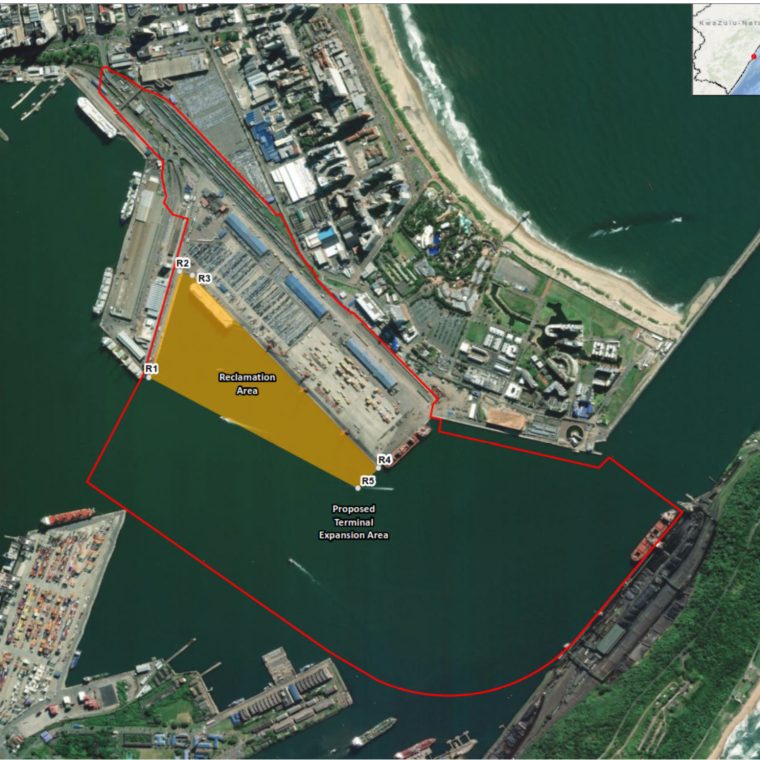
Under the plan, TNPA intends to consolidate sections of the port’s Point Precinct into a single, expanded container terminal – known as the Point Container Terminal. The reclamation would occur between the existing Point multi-purpose terminal quay wall and a planned new quay wall.
The project involves reclaiming approximately 22.4 hectares of land using an estimated 4 million cubic metres of infill material, primarily sourced from an authorised offshore sandwinning site near the harbour entrance.
TNPA’s long-term objective is to increase the port’s container throughput capacity to between 10 million and 11 million twenty-foot equivalent units (TEUs). Planned upgrades include deeper berths to accommodate larger vessels, expanded stacking areas for containers, new quay walls and improved rail connectivity.
If approved, the reclaimed land will be used for developing the following:
- a new quay wall, berthing for container vessels;
- infrastructure that accommodates ultra-large container ships (ULCS);
- operating harbour cranes;
- stacking containers (meaning more land for stacking containers on top of each other in blocks
grouped by imports, exports); and - the availability of land and water areas for future expansion.
Environmental considerations
The port expansion is expected to enhance operational efficiency and reduce congestion, ultimately lowering the cost of doing business in South Africa. Officials say the project could unlock new economic opportunities and strengthen the country’s position in global trade networks.
However, the reclamation process — requiring dredging and infilling — raises environmental considerations. Potential impacts include increased water turbidity and disruption to benthic ecosystems, as well as temporary effects on fish stocks entering the harbour.
The Department emphasised that approval under the ICM Act does not replace the need for a full environmental authorisation process under the National Environmental Management Act, 1998, which will assess broader environmental impacts.
Public participation process
In line with statutory requirements, the Minister has initiated a public consultation process to gather input on the proposal. The ICM Act mandates that coastal public property be managed sustainably and equitably, ensuring that developments do not undermine environmental integrity or public access.
Interested stakeholders and members of the public have 60 days from the date of publication to submit written representations. Submissions received after the deadline may not be considered.
The application documents are available online via the Department of Forestry, Fisheries and the Environment or can be requested electronically or in hard copy by prior arrangement.
A copy of the pre-approval application can be accessed and downloaded here or can be obtained electronically upon request by email to reclamation@dffe.gov.za. A hard copy can also be obtained from
the Department’s offices at the address indicated below by prior arrangement with the person indicated for enquiries.
Members of the public are invited to submit written representations on the pre-approval application within 60 days after publication of this notice in the Gazette or publication of a notification in the newspaper, whichever is the later date. Written representations received after 60 days may be disregarded.
The Department of Forestry, Fisheries and the Environment complies with the Protection of Personal Information Act, 2013 (Act No. 4 of 2013). Comments received and responses to those comments are collated into a comments and response report, which will be made available to the public as part of the consultation process. If you have any objection to your name being made publicly available in the comments and responses report, that objection should be highlighted in bold as part of the comments submitted.
All representations must be submitted in writing to the Department through the following channels:
By hand: The Deputy Director-General
Attention: Mr Ryan Peter
Department of Forestry, Fisheries and the Environment
Branch: Oceans and Coasts
East Pier Building No. 1, East Pier Road, V&A Waterfront
CAPE TOWN
8000
By email: reclamation@dffe.gov.za
Enquiries: Mr Ryan Peter on 079 501 8709