

RISING global tensions and shifting domestic politics are reversing the benefits of easing macroeconomic conditions. This is reflected in the decline in business confidence as measured by the Durban Business Confidence Index (DBCI) in the City of Durban from 60.74 in the fourth quarter of 2024 to 56.32 in the first quarter of 2025.
Prof Harold Ngalawa and Dr Ntokozo Nzimande from the Macroeconomics Research Unit at the University of KwaZulu-Natal say the index captures the mood or sentiment of businesspeople in their day-to-day business in Durban. Despite the reported decline, the mood remains positive, indicating the efficacy of the interventions to rehabilitate the city. Hence, there is a need for proactive and determined interventions, such as promoting Durban and infrastructure development.
The Durban BCI
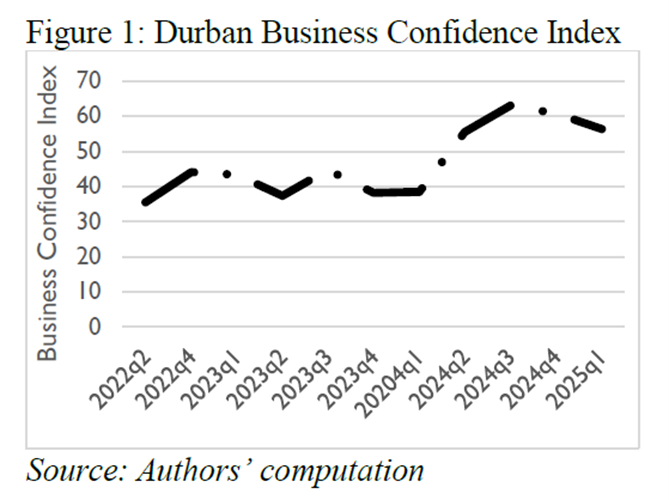
The index fell from 60.74 index points in the fourth quarter of 2024 to 56.32 in the first quarter of 2025. This represents a quarter-on-quarter (q-o-q) 7% decline in confidence in the Durban business climate, marking a second consecutive decrease in business confidence.
In the fourth quarter of 2024, the index deteriorated by 3.6% compared to the third quarter of the same year. Notwithstanding this, the index remains comfortably above the 50-point mark—the neutrality zone. On a year-on-year basis, business confidence in the city significantly improved, rising from 38.42 in the first quarter of 2024 to a 47% increase in the first quarter of 2025. This suggests that business conditions are considerably better than they were in 2024, primarily due to interventions aimed at revitalising the City of Durban, according to Ngalawa and Nzimande.
They say the Durban BCI generally moves in the same direction as the national BCI. However, in the final quarter of 2024, the two indices diverged. In the present quarter, the national business confidence index remained unchanged at 45, while the DBCI experienced a 7% q-o-q decline. These differences reflect variations in the timing of data collection. The national data was collected in February, while the City’s data was gathered in the last two weeks of March. Hence, the latter captures recent developments in the domestic and international political and economic domains.
On the local front, disagreements within the government of National Unity (GNU) threaten the sustainability of the current government arrangements and, more importantly, create policy uncertainty, say Ngalawa and Nzimande. The uncertainties at the national government level spill over to “coalition” governments in the provinces, resulting in business environment uncertainty. Ongoing global tensions, breakdowns in diplomatic relations, and uncertainties regarding the future of the African Growth and Opportunity Act (Agoa) are among the issues affecting the trade landscape and economic stability.
The overall index, however, hides substantial differences across the sectors. For example, some sectors, such as Community, Social, and Personal Services; Manufacturing; and Agriculture, hunting, forestry, and fishing, recorded improvements, whereas, construction, Financial Intermediation, insurance, real estate, and business, among others, recorded deterioration in confidence.
In particular, the wholesale and retail trade, repair of motor vehicles, motorcycles, and personal and household goods, as well as catering and accommodation, recorded a sharp decline in confidence. Confidence in this sector declined from 67.34 in the fourth quarter of 2024 to 43.79 index points in the first quarter of 2025. On a q-o-q basis, the sector recorded a 35% decline. However, year-on-year, it recorded a 9% improvement.
Manufacturing, on the other hand, a sector often credited for its job-creation capacity, experienced improvements. The confidence in this sector is reported at 61.71 index points in the first quarter of 2025, up from 55.54 in the fourth quarter of 2024. This represents an 11% increase. In 2024 Q1, confidence in the manufacturing sector was reported at 39.83. Therefore, year-on-year, this sector recorded a 55% improvement. This reflects improvements in the electricity supply, which constrained the manufacturing industry, the researchers explain.
Business confidence in the construction industry declined by 11% from 66.25 in the fourth quarter of 2024 to 58.73 in the first quarter of 2025. Transport, Storage, and Communication witnessed a large drop in business confidence (17%) from 70.58 in the final quarter of 2024 to 58.89 index points in the first quarter of 2025. Financial intermediation, Insurance, Real estate, and business remained optimistic, although the levels of optimism declined by 19%, from 67.69 in the fourth quarter of 2024 to 54.85 in the first quarter of this year.
The researchers say the confidence in this sector is due to the easing of macroeconomic conditions. However, the hanging cloud of uncertainty, including rising levels of government indebtedness, is working against these gains.
Business confidence in the agricultural sector is exceptionally high, with the industry registering 83.10 points in the first quarter of 2025. Severe drought conditions in 2024 resulted in a significant 30% reduction in agricultural sector output. However, the phenomenon of La Niña is expected to bring higher quantities of precipitation, thus boosting confidence in agriculture, hunting, forestry, and fishing.
Community, Social, and Personal services recorded a narrow increase in confidence from 49.29 index points in the fourth quarter of 2024 to 50.30 in the first quarter of 2025. This represents a 2% improvement in business confidence.
In conclusion, for the second consecutive quarter, Durban registered a decline in confidence from 60.74 index points in quarter four of 2024 to 56.32 in the first quarter of 2025. Although this is a worrying trend, businesspeople remain optimistic about business conditions in the City. This resilience is partly due to the interventions by the President in establishing the Presidential eThekwini Working Group (PeWG), aimed at stabilising and revitalizing the city. Therefore, we advocate for proactive measures such as promoting Durban and rehabilitating its infrastructure, say Ngalawa and Nzimande.
Service delivery
According to the research, perceptions of service delivery in Durban worsened in the first quarter of 2025. In the Survey of Business Opinion conducted in 2025 Q1 in Durban, 70% of the respondents (compared to 57.6% in the previous quarter) reported that if they (or anyone) complained about poor service delivery, it is unlikely that the local municipality would deal with it within a reasonable time frame. A large proportion of respondents (30%) reported that management of the environment (sewerage, solid waste, and parks) is the poorest service provided by the authorities followed by roads (24%), water (18%), public safety (16%), and public safety (police, fire and ambulance) (12%).