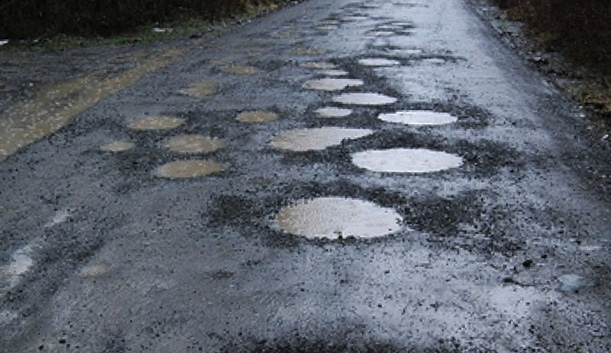

THE rainy season in most of South Africa has once again exposed the dire state of municipal road networks across the country. From metros to small towns, potholes are multiplying and growing rapidly, disrupting mobility, damaging vehicles, increasing accident risks and fuelling public frustration.
Yet potholes themselves are not the real problem, says The Institute of Municipal Engineering of Southern Africa (Imesa). They are the most visible symptom of road maintenance delays and underinvestment. “The greatest challenge is not filling potholes, but convincing decision makers that the sound operation and maintenance of existing assets should be prioritised over investment in new infrastructure.”
The South African road network of over 750 000km is the tenth longest in the world. Municipalities manage over 256,000 km of this network, and an estimated 131,000 km is unproclaimed. The road replacement cost is estimated at R2 trillion. Given the extent of the network to be managed, it is critical for municipalities to prioritise road maintenance. Imesa warns that neglect will result in the ongoing deterioration of assets and a huge knock to the economy that will be compounded with the inflated costs of reconstruction over time.
Citing the findings of an important research paper that was shared with the more than 700 engineers and municipal officials who attended the 2025 Imesa Conference, the institute states that delaying road maintenance is a false economy. The longer such maintenance is left undone, the higher the eventual cost to restore the road to an acceptable condition. The paper’s authors, Ashiel Rampersad, Melusi Nkosi, Obey Manganyi and Jabulani Vincent Mashinini from the Council for Scientific and Industrial Research’s (CSIR) Smart Mobility cluster, set out to understand the readiness of municipalities to manage an ageing local road network, given their internal and external challenges.
Missing systems
Some of their findings were concerning, but Imesa notes that recognising the issues and planning the way forward is the first step towards improving service delivery. The authors found that 59% of municipalities are unaware of their road network conditions, primarily due to missing assessment systems. A limited number of municipalities have appropriate systems and policies in place to manage their road network, and the consequences of the widespread underfunding of road condition maintenance are seldom assessed by roads authorities.
The writers reviewed 41 municipal Integrated Development Plans (IDPs) to understand how their road assets are prioritised. They noted that local governments should be able to leverage their existing knowledge, skills and resources to meet their goals effectively. Achieving this requires stronger institutional capacity to manage operations and service delivery. However, most municipalities currently lack the capability to consistently produce reliable and transparent performance reports, highlighting significant institutional weaknesses. Less than half of municipalities have road asset management, infrastructure or transport plans.
Municipalities, on average, spend more on newly constructed roads as opposed to maintenance of existing roads, Smith et al. found. They noted that this trend highlights the widespread underinvestment in infrastructure prioritisation.
A concept framework for road infrastructure management developed by the writers was shared with Imesa Conference attendees. As potholes continue to rile road users and test municipalities around the country, Imesa urges municipal engineers to use this powerful tool at their disposal.
More than ‘fixing potholes’
“The shortage of skills is also recognised as a major threat to local roads infrastructure management, so the education, knowledge sharing and professional development offered by Imesa is vital. Since 1961, the institute has been committed to the pursuit of excellence in all facets of infrastructure, offering a platform for the exchange of ideas and viewpoints on all aspects of municipal engineering with the aim of expanding the knowledge and best practices are invited to be part of this community.