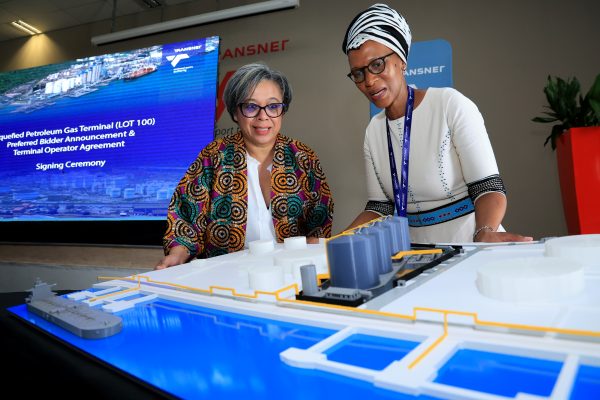

TRANSNET officially handed over a Terminal Operating Agreement (TOA) to a joint-venture between Wasaa Gasses and the state-owned energy holding company, the Central Energy Fund to build and operate a liquefied petroleum gas (LPG) facility during an event it hosted at its Pier 1 auditorium on 12 December 2025.
In addition to the official TOA, Transnet National Ports Authority’s (TNPA) acting chief executive, Mohammed Abdool, presented the JV with a permit to operate in the Island View precinct, where strict safety regulations are in place due to the highly flammable and dangerous nature of oil and gas transported and stored at the site.
Drawn-out process
TNPA initially issued a Request for Proposals (RFP) for the 25-year concession in December 2022, after cancelling a previous tender for the Lot 100 site in 2019. An award letter was issued to the Wasaa CEF JV in July 2024. Transnet has framed the prolonged journey from RFP to TOA as “rigorous” and “long-awaited”.
Since 2022, a new wave of top executives has taken over at Transnet, the most recent appointment being Mohammed Abdool as acting chief executive of TNPA in September 2025, after that position was vacated by Pepi Salinga in July.
Public-Private Partnership
Nokwanele Qonde, Wasaa CEF JV director explains that the company name is a Swahili word that means “opportunity” and not an acronym.
Transnet commended Wasaa as a trusted operator, as it already operates liquid fuel terminals in East London and Matola in Mozambique.
Qonde explains that the East London terminal was established in 1920 and acquired by Wasaa Terminals, a subsidiary of Wasaa Group, from bp Southern Africa in 2022. “The terminal has a substantial capacity of approximately 64 million litres and stores various bulk fuels, including diesel, unleaded petrol, jet fuel and kerosene.”
“Since its inception, Wasaa has managed to entrench its position in the LPG sector and secure contracts with major oil companies. Our operations were not limited to being LPG wholesalers, we also diversified our operations to include terminal operations, commodities and trading, chemicals, and logistics.”
In the process of developing new business, Qonde says the company partnered with Mozambican state-owned company, Petróleos de Moçambique (Petromoc). “Wasaa was tasked with undertaking maintenance, repairs and/or replacement of the old Petromoc spheres at its own cost for its utilisation over the years.”
“We continue to be major players in the supply of LPG in the SADC region,” she says.
Qonde would not confirm whether the JV will be working with any technical partners. “We will be able to establish the exact nature of the technical capabilities required during each of the phases, namely the development, construction, operating and maintenance stages,” she said.
She added that the company is pleased that this facility will have a positive multiplier effect on adjacent industries in the area.
With regards to offtakers, Qonde says Wasaa has supply agreements with major oil companies such as Sasol, Astron Energy, bp, Engen and Shell. “The company has been exporting to the SADC market over the last 10 years,” she said.
She says the JV is governed by a confidentiality agreement for competitive reasons, which prevents it from disclosing any details of the partnership.
State-of-the-art facility
According to Wasaa, the state-of-the-art facility, to be known as Lot 100 Terminal, will be equipped with simultaneous ship unloading and road tanker loading, while vapour recovery operations will be enabled without operational interference. The integrated piping and valve network will permit flexible product transfer from any storage tank to any designated pump station or loading bay.
“Lot 100 intends to import, store, and dispatch propane, butane as well as an LPG mix. The terminal will trade stenched and unstenched LPG,” said Qonde.
The terminal will be connected to multiple berths, and has been designed to import and export LPG via marine vessels ranging from small gas carriers to very large gas carriers (VLGCs) up to 64,000 Deadweight Tonnage (DWT).
The terminal will be the largest LPG import facility in South Africa, with a storage capacity of approximately 30,000 tonnes. Five bay loading gantries with automatic weighbridge systems will facilitate fuel transfer.
According to Transnet, the agreement will result in a 50,000 m³ LPG terminal storage and handling capacity – a comprehensive solution addressing the growing demand, particularly in KwaZulu-Natal and the Eastern Cape hinterland. The terminal, which is expected to be completed by 2027, will have capacity to dispatch up to 800 m³ per hour of heated LPG mix. This will provide essential supplies to various industrial markets and produce specific grades suitable for residential use, Transnet said in a statement.
Transnet estimates the project’s investment value at approximately R1.4 billion.
The Development Bank of South Africa (DBSA) holds the funding rights and is the lead arranger for the deal.
According to Wasaa, Lot 100 Terminal is planned to come into commercial operation in the fourth quarter of 2027.
SA’s LPG market
According to the non-profit industry body, Liquified Petroleum Gas Association South Africa (LPGSA), the South African LPG market is poised for significant growth. Factors such as rising electricity prices and the need for cleaner energy alternatives have increased LPG demand. It says on its website that in 2024, LPG consumption rose to 500,000 tonnes from 425,000 tonnes the previous year.
But growth in LPG consumption has not been consistent. The Fuels Industry Association of South Africa, representing a diverse range of energy sources, published fuel consumption trends in its 2024 annual report.
According to the data, sourced from the Department of Mineral Resources and Energy, LPG consumption in the country surged from 398 million litres in 2014 to 588 million litres in 2015.
From that high in 2015, LPG consumption dropped steadily to 448 million litres in 2020, plunging to 308 million litres in 2021. In 2024, national consumption was estimated at 279 million litres.
Domestic production of LPG has been severely impacted by the closure of local oil refineries, as LPG is produced as a byproduct in the process of refining crude oil. In 2019, the aggregate LPG production from all South African refineries (Engen, Sapref, Natref, Chevref/Astron, PetroSA and Sasol) was consistently around 300,000 tonnes per annum. Since Engen and Sapref in Durban were the two largest producers, they collectively accounted for a significant majority, estimated to be well over 50% (and potentially up to 70%) of the country’s total refinery LPG output.
Engen halted production in mid-2020 and Sapref in March/April 2022. Imports now dominate the supply chain, accounting for upwards of 70% of the national supply.
There are currently two major LPG import terminals in South Africa. In Richards Bay, Bidvest Tank Terminals (BTT) started operating its LPG terminal in late 2019/early 2020, with the first LPG arrivals in late 2019, targeting commercial use by Q4 2019. The facility has a total capacity of 22,600 tonnes, featuring four large storage bullets. Petredec, a leading global LPG shipping, trading, and terminal platform, initiated the project and is the primary offtaker of the storage facility.
At Saldanha on the West Coast, Sunrise Energy developed an LPG terminal on a 30-year concession from Transnet. The first phase of the terminal has a receiving or working storage capacity of 5,500 tonnes of LPG, in the form of five mounded pressurised storage bullets. Throughput capacity in excess of 17,500 million tonnes per month can be achieved through these facilities.
The LPG terminal in Saldanha started operations in 2017, following a trial shipment at the end of May 2017, with its formal launch and unveiling in August 2017, marking Africa’s largest open-access import facility.
*The original version of this story has been edited to add the LPGSA source quoted.